Are H0035 Claims Getting Denied? Common PHP Billing Problems and Strategies to Protect Behavioral Health Revenue
November 4, 2026
Delirium ICD 10 Coding: How Accurate Diagnosis Reporting Helps Prevent Psychiatry Billing Errors and Claim Denials
November 6, 2026
Mental Health CPT Codes for 2027: Is Your Practice Prepared for Changing Coding Requirements?
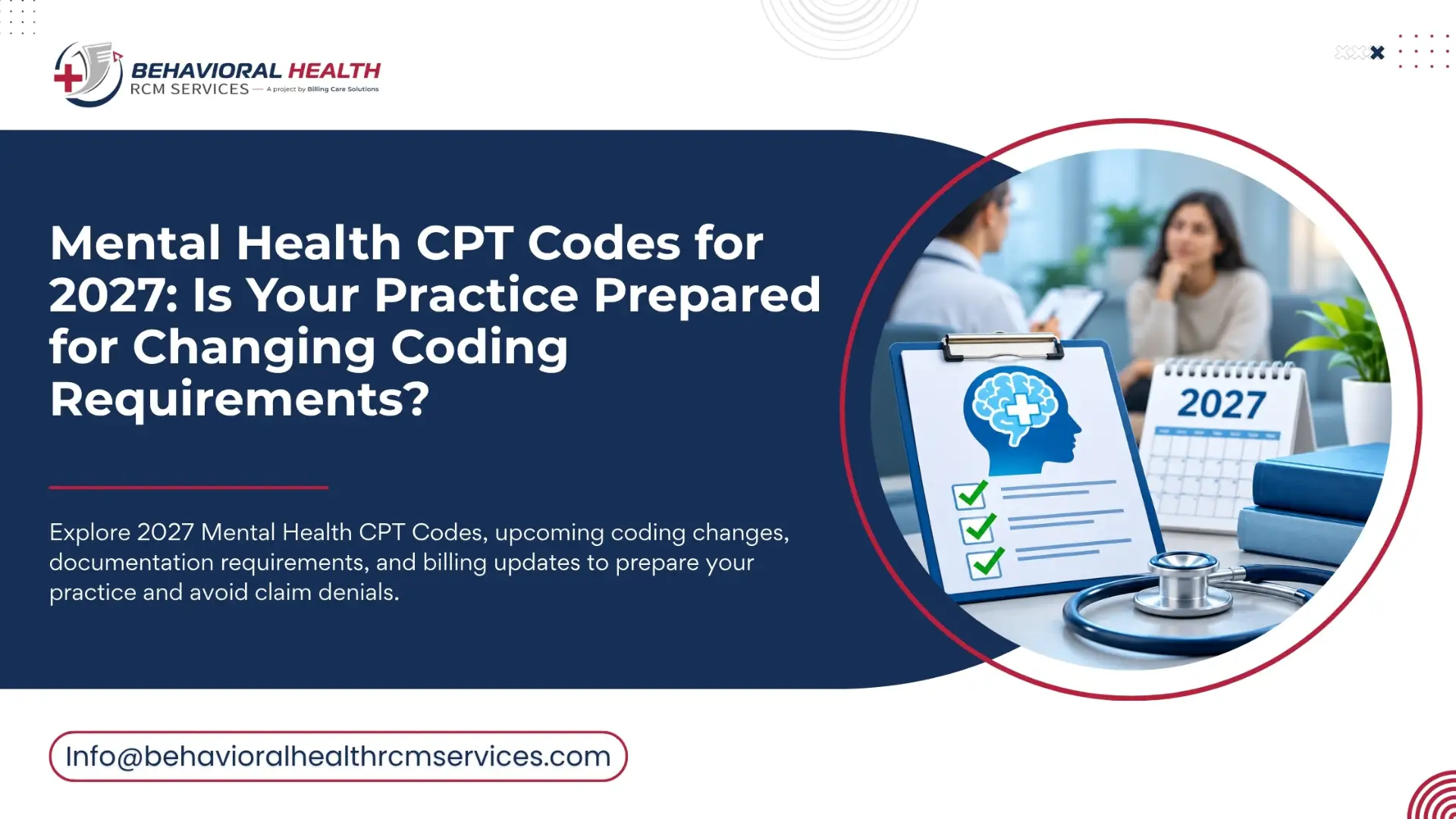
The 2027 CPT code changes include some major changes to the billing landscape. Especially if you are a behavioral health provider offering applied behavior analysis (ABA) and adaptive behavior services. Mental Health CPT Codes aid psychiatrists, psychologists, therapists, and behavior health specialists in reporting it correctly. In order to prepare billing operations for the new year, it is necessary to understand the codes that have been changed, the codes that have not changed and the codes that were deleted.
The American Medical Association (AMA) published the 2027 CPT code set that featured 299 new codes, 74 revised codes, and 80 codes deleted from specialty medical codes. The figures quoted are, however, for changes to the whole of the CPT code set and not for mental health coding. The most salient update in Behavioral Health is six new adaptive behavior codes, changes to codes 97151-97158 and removal of codes 0362T and 0373T.
The already existing psychiatric evaluations and psychotherapy code families are significant for traditional mental health. Although formal policies may go so far as to include specific CPT codebooks and payer-specific instructions, they should still review these official policy details before implementing their 2027 billing processes. Because the Mental Health CPT Codes are also reviewed, they are ideal for organizations to use as a support in determining what coding tasks need to be taken care of in coming up with the coding guidelines for the new year.
New, revised and deleted behavioral health codes, what their change means and practical steps practices can take to ensure code accuracy and proper reimbursement.
What Are Mental Health CPT Codes?
Mental Health CPT Codes are professional services provided to a patient with mental, emotional and behavioral health conditions that are represented by standard procedure codes. These codes are used to describe the services rendered during a visit to the healthcare organization and enable insurance carriers to handle claims for reimbursement.
By mastering Mental Health CPT Codes, billing teams can ensure accurate codes alignment with the services documented in clinical records. The codes are used by psychiatrists, psychologists, licensed clinical social workers, therapists and other trained professionals for behavioral health claims. They report according to the services provided, as well as provider qualifications, clinical documentation, and policies of the payers.
There are three CPT codes in particular to take into account when dealing with mental health billing.
- Professional services, such as psychological testing, psychotherapy and psychiatric evaluation, are specified by CPT codes.
- ICD-10-CM codes indicate the patients' documented mental health difficulty or diagnosis.
- The purpose of HCPCS is to provide codes for services, supplies and healthcare activities not adequately described in CPT coding.
As a general guideline, if the therapy session is documented and its time requirements are complied with, this therapist may report CPT 90834 for an individual psychotherapy session. The related ICD-10-CM diagnosis is used to describe the condition that the treatment is being provided to address. Additionally, the selection of the correct Mental Health CPT Codes involves verifying session length, provider eligibility and payment requirements.
The codes must accurately reflect the clinical encounter in order to enable accurate reporting. In order to be considered a medical necessity, a correct procedure code must be accompanied by medical necessity documentation. The clinical record needs to have those references in relation to the services provided and the needs of the client. Practices are advised to use Mental Health CPT Codes in conjunction with Mental Health and Psychiatric related ICD-10-CM diagnoses in order to accurately report claims.
What Is Changing in Mental Health CPT Codes for 2027?
There are a number of medical specialty updates in the 2027 CPT update. But, as with all code changes, behavioral health practices should look at what each specific code change means to services instead of it being a mental health update. Practices should check the Mental Health CPT Codes and be sure they are appropriate for their practice in 2027 in comparison to those that have been published.
The code family with the most major behavioral health coding change are adaptive behavior services.
|
Update Category |
2027 Changes |
Effective Date |
|
New adaptive behavior codes |
Six new codes |
January 1, 2027 |
|
Revised adaptive behavior codes |
Eight revised codes, 97151 through 97158 |
January 1, 2027 |
|
Deleted adaptive behavior codes |
0362T and 0373T |
January 1, 2027 |
|
Established psychiatric evaluation codes |
No announced changes identified in published update materials |
Verify official codebook |
|
Established psychotherapy codes |
No announced changes identified in published update materials |
Verify official codebook |
These changes primarily affect ABA providers, behavior analysts, and organizations delivering adaptive behavior services.
Existing code libraries should be reviewed, but should not assume the need to update the code libraries as this approach is conventional psychiatric/mental health and psychotherapy.
New Mental Health CPT Codes for 2027
There are six codes for adaptive behavior services added in the 2027 CPT. The additions focus on particular assessment, treatment, technician participation, and non-face-to-face clinical activities. The new Mental Health CPT Codes will enable more granular reporting for qualifying mental health services and allow more specific coding.
|
New CPT Code |
2027 Service Description |
|
97148 |
Behavior identification-supporting assessment of harmful behavior involving two technicians |
|
+97149 |
Each additional technician participating in the qualifying assessment |
|
97159 |
Adaptive behavior treatment of harmful behavior involving two technicians |
|
+97160 |
Each additional technician participating in the qualifying treatment |
|
97173 |
Adaptive behavior treatment with analysis, performed face-to-face by a qualified healthcare professional |
|
97180 |
Non-face-to-face adaptive behavior services performed by a physician or qualified healthcare professional |
Mental Health CPT codes should be reviewed by ABA billing teams prior to updating their internal coding reference.
CPT 97148: Assessment of Harmful Behavior
CPT 97148 is used when there are testing activities that support and document the performance of qualified behaviors, performed directly with a patient by two technicians. The service is designed to deal with the destructive behavior and individual patient environment to suit the patient's behavioral needs.
Technician involvement, Evaluation activities, Patient behavior, and Individualized treatment environment. Mental Health CPT Codes will require documentation that meets the following elements to be used accurately: documentation for the assessment structure; documentation of technician involvement.
CPT 97149: Additional Technician Assessment
CPT 97149 is used as an additional code to the main code for each additional technician involved in a qualifying assessment for harmful-behaviors.
Must be used with the corresponding main assessment code. The Billing Team needs to report as directed, and document the involvement of the added technician. The additional technician involvement needs to be clearly documented in these Mental Health CPT Codes.
CPT 97159: Treatment of Harmful Behavior
CPT 97159 is used to keep a record of adaptive behavior treatment performed by two technicians with a patient engaging in harmful behavior.
The treatment is delivered in a behavioral treatment environment, which is individualized to the patient's treatment needs. Treatment activities, technician involvement, and applicable clinical requirements should be supported by documentation. Before making claims for Mental Health treatment, billing staff will want to verify that it is appropriate by checking the clinical documentation against the Mental Health CPT Codes.
CPT 97160: Additional Technician Treatment
A single qualifying adaptive behavior treatment (CPT 97159) documents one additional technician participating in the treatment (CPT 97160).
This add-on code will require supporting documentation and be reported according to the relevant primary code reporting rules. Setting up this code in practices needs to be confirmed by the practices against the reporting requirements, before incorporating into practices' billing process.
CPT 97173: Adaptive Behavior Treatment With Analysis
CPT 97173 is for adaptation therapy, face-to-face by a physician or other qualified health care provider for one patient.
Any provider is required to record the clinical activities, treatment analysis, patient involvement, and time spent on the clinical work reported for the clinical services. They should ensure that the code is in line with applicable requirements prior to use. Reading through Mental Health CPT Codes can also enable teams to differentiate between professional treatment activities and technician administered services.
CPT 97180: Non-Face-to-Face Adaptive Behavior Services
CPT 97180 refers to service for adaptive behavior services performed by a physician or a qualified health care professional in a non-face-to-face environment as long as there is adjustment.
The activities involved in these include treatment data review, analysis of clinical/therapeutic progress, treatment decision making, treatment/boutique modulations, and when relevant, preparation for transition or discharge plans.
Diagnostic and treatment choices should be documented in the medical record and based on the services performed. Practices should ensure that the documentation is consistent with the qualifying non-face-to-face service.
Revised Mental Health CPT Codes for 2027
There are eight existing codes for adaptive behavior codes that undergo revision in the 2027 release. The revisions make service descriptions and reporting for assessment, treatment, direction by technicians and guidance by caregivers clearer. Practices should refer to the current Mental Health CPT Codes and the Mental Health 2027 Descriptions.
|
Revised CPT Code |
Updated Service Focus |
|
97151 |
Behavior identification assessment by a physician or qualified healthcare professional |
|
97152 |
Behavior identification-supporting assessment administered by a technician |
|
97153 |
Adaptive behavior treatment by protocol, administered by a technician |
|
97154 |
Group adaptive behavior treatment by protocol, administered by a technician |
|
97155 |
Adaptive behavior direction of technician and analysis by a qualified healthcare professional |
|
97156 |
Family adaptive behavior treatment guidance with analysis |
|
97157 |
Multiple-family group adaptive behavior treatment guidance with analysis |
|
97158 |
Group adaptive behavior treatment with analysis |
Changes to CPT 97151
CPT 97151 is used for a physician or qualified health care professional conducting a behavior identification assessment.
This updated description includes assessments in face-to-face environments and assessment for qualifying non-face-to-face work. This involves reviewing past records, evaluating results of assessments and drawing up reports and treatment plans.
Practices need to include documentation that represents the assessment activities that they have conducted.
Changes to CPT 97152
Data obtained by a technician to evaluate the behavior for the purpose of identifying it is coded separately: CPT 97152, Behavior identification-supporting assessment.
The updated description details the job function of the technician and face-to-face evaluation needs. Billing teams to check the involvement of the technician and clinical items. Practices should also review their Mental Health CPT Codes reporting requirements to avoid confusion of coding activities for technicians versus professional assessments.
Changes to CPT 97155
CPT 97155 reports adaptive behavior direction of a technician and analysis performed by a physician or qualified healthcare professional.
The updated description has made the professional role of directing treatment and determining the patient's response more explicit.
Documentation should clearly show the professional's work and differentiate it from the activities as the technician. To report Mental Health CPT Codes accurately, there is a need to clearly distinguish between the activities by the technician and the analysis by the professional.
Changes to CPT 97156 and 97157
CPT 97156 is the family adaptive behavior treatment guidance with one patient analyzed. CPT 97157 depicts multiple-family group adaptive behavior treatment guidance along with analysis for multiple patients.
Revised descriptions ensure that participation by caregivers, treatment information and the appropriate service arrangement are clarified.
Changes to CPT 97158
CPT 97158 is the code for group adaptive behavior treatment performed by a physician or qualified health care professional.
The wording in the updated description is updated to make clear the role of the professional and the criteria for a Multiple Patient Group Treatment.
Documentation and service classification are especially critical for all ABA providers to ensure the accuracy of their billing.
Deleted Mental Health and Behavioral Health CPT Codes for 2027
Two previous Category III codes will be removed from the 2027 update to the CPT.
|
Deleted CPT Code |
Previous Service Description |
2027 Status |
|
0362T |
Behavior identification-supporting assessment involving multiple technicians and harmful behavior |
Deleted |
|
0373T |
Adaptive behavior treatment with protocol modification involving multiple technicians and harmful behavior |
Deleted |
This is the point at which these codes will no longer be accepted for dates of service that will start on January 1, 2027.
Practices must remove these as current billing reference and see through the code structure before claiming for services provided in 2027. When Mental Health CPT Codes are deleted from any active billing references, it helps to avoid selection of an outdated CPT Code.
New reporting options give further specific descriptions of some of the qualifying activities. But providers should not presume a 1-to-1 replacement for all previous billing scenarios. The final service description and guidelines for reporting determine the code assigned.
Are Psychiatric Evaluation and Psychotherapy CPT Codes Changing in 2027?
It is a significant question in the world of traditional mental health practices. Changes to the commonly used psychiatric evaluation and psychotherapy code families do not appear in the published materials for 2027.
These codes are still relevant to standard psychiatric/out-patient mental health billing. Should official guidance point to change, then the Established Mental Health CPT codes should be removed from practice references.
|
CPT Code |
Service Description |
2027 Update Status |
|
Psychiatric diagnostic evaluation without medical services |
No announced revision identified |
|
|
90792 |
Psychiatric diagnostic evaluation with medical services |
No announced revision identified |
|
Individual psychotherapy, 30 minutes |
No announced revision identified |
|
|
Individual psychotherapy, 45 minutes |
No announced revision identified |
|
|
Individual psychotherapy, 60 minutes |
No announced revision identified |
|
|
Family psychotherapy without the patient present |
No announced revision identified |
|
|
Family psychotherapy with the patient present |
No announced revision identified |
|
|
Group psychotherapy |
No announced revision identified |
|
|
90833 |
Psychotherapy add-on, 30 minutes |
No announced revision identified |
|
90836 |
Psychotherapy add-on, 45 minutes |
No announced revision identified |
|
90838 |
Psychotherapy add-on, 60 minutes |
No announced revision identified |
For instance, 90832, 90834 or 90837 reports should still get reviewed by psychiatrists and therapists as to session length, documentation and medical necessity.
The codes in this list should not be changed because the 2027 CPT Revision includes new adaptive behavior codes. Practices should be able to differentiate current psychiatric and psychotherapy codes from the adaptive behavior changes that are added to this year (2027).
Practices should also audit the official 2027 CPT codebook as well as specific payer coding policy prior to coding. The verification helps to assure that the coding references are in alignment to the requirements for their services and payers.
How the 2027 CPT Updates Affect Behavioral Health Billing
In addition to the list of codes within a billing system, new and updated codes have an impact on several other areas. They also affect clinical documentation tasks, technician workflows, claim preparation and Payer communications. Coordination of clinical documentation, billing software and payer requirements is necessary when Mental Health CPT Codes are being changed.
ABAs/organizations ought to assess their existing procedures and process for documenting the services being delivered using the new adaptive behavior code family.
Updated Clinical Documentation Requirements
Practices are asking to review documentation for assessment and treatment activities, since the updated code descriptions will be used.
Teams should double check clinical records for identification:
- The service performed.
- The person providing the service (professional/technician).
- Patient participation.
- Applicable treatment activities.
- Time supporting the reported service.
- Diagnosis and management of patients.
- Caregiver involvement (if applicable).
Properly document services conforming to the services that are reported on a claim. It should also accommodate the code chosen in compliance with the relevant reporting standards. The key to accurate Mental Health CPT Codes reporting is the complete clinical notes and properly codified, defined service activities.
Billing Software and Code Library Updates
All practices will need to act now and upgrade their billing software before the 1st January 2027.
Codes should be removed from current dates of service code selection options. New and revised codes will be listed and displayed with accurate descriptions and effective dates.
It is also important to see if the merchant, clearinghouse, and billing, practice management software solutions have incorporated the updated code set. Before submitting 2027 claims, they should have some trial runs with code selection and claim edits. The new Mental Health CPT Codes should also be displayed in the respective coding references and billing templates in an internal coding system.
Payer Coverage and Authorization Verification
Coverage and reimbursement do not automatically imply if a new CPT code is approved.
Commercial health plans, as well as Medicaid programs and other payers determine their own coverage and implementation policies.
Practices should verify:
- Whether the new codes are already recognized by the payer.
- If a prior authorization is required.
- To determine if and what changes are necessary to existing authorizations.
- If rates are available, where they are and what they are.
- Whether the instructions in payer billing manuals have been updated.
- Does this need further evidence of your claim?
This process to ensure verification will help avoid unnecessary claim denials and reimbursement delays. There should also be an investigation into payer updates after implementation to be watched by the billing teams. how the newly added mental health CPT Codes will be processed on claims is based upon payer-specific guidance.
How to Prepare Your Practice for Mental Health CPT Code Updates in 2027
Clinical staffing, coding, billing and practice management need to work together to prepare for the 2027 changes. Structured Review of Mental Health CPT Codes can assist billing managers in identifying mental health CPT code implementation gaps before the cutover date of January 1, 2027.
Follow this checklist when checking your billing operation.
|
Preparation Task |
Recommended Action |
|
Review the 2027 CPT code set |
Identify changes relevant to your services |
|
Update code libraries |
Add new codes and revised descriptions |
|
Remove deleted codes |
Disable 0362T and 0373T for 2027 dates of service |
|
Review clinical documentation |
Update templates for revised service requirements |
|
Train billing teams |
Explain new and revised reporting rules |
|
Verify payer policies |
Confirm coverage and reimbursement requirements |
|
Review authorization workflows |
Identify any changes needed for existing approvals |
|
Update billing software |
Confirm code availability and effective dates |
|
Conduct claim audits |
Identify incorrect code selection and reporting |
|
Monitor reimbursement |
Review denials and payment discrepancies |
Mental health services should work towards confirming the codes that they already have for psychiatric and psychotherapy services. ABA providers will need to engage in a more thorough implementation review as their adaptive behavior code family will be changing. Internal audits of Mental Health CPT Codes every few weeks or months can be very effective in helping practices spot reporting issues before they impact reimbursements.
Medicare Payment and Reimbursement Considerations for 2027
That's a different story as far as CPT code changes or Medicare reimbursement rates. A new payment rate is not automatically created when a code description is revised.
CMS tackles reimbursement in the Medicare Physician Fee Schedule. Payment is based on relative value units, geographic adjustments, conversion factors and coverage policies.
Additionally, behavioral health payment policies are covered in the proposed rule for the CY 2027 Physician Fee Schedule. Practices need to keep different plans from the settling of payment requirements for proposals and finalized from their revenue cycle planning for 2027.
There are several items that billing managers need to check:
- 2027 Medicare fee schedule (MFS) amounts that apply.
- Work and practice RVUs.
- Geographic Practice Cost Indices.
- Eligibility and enrollment in providers.
- Payer-specific reimbursement policies.
- Payment rules for new adaptive behavior codes.
When a new code is developed, it is important to not presume that the amount of the code will be immediately reimbursed at the level of payment by Medicare or commercial insurance carriers. Enforce designation of the payment status and direction to implement payments. The practices should also review the interactions of services reported to Medicare with each individual payer reimbursement policies.
How Behavioral Health RCM Services Supports Accurate Mental Health Billing
Proper coding, thorough documentation, and regular audit of claims will be necessary to manage the updates of the 2027 CPT codes. Behavioral health practices must also keep an eye on payers' requirements, ensure that patients are covered, and meet reimbursement challenges before it impacts cash flow. With experience spanning more than 17 years in the behavioral healthcare industry and these tools strongly grounded in advanced AI automation and financial clarity, Behavioral Health RCM Services is ready to tackle the challenges.
They aid practices in mental health coding, claim accuracy, checking insurance coverage, handling insurance denials, and tracking revenue cycles. You can have organized billing processes and detect reimbursement issues with every psychotherapy, psychiatric services and ABA therapy effort your organization undertakes with the help of your RCM support. Discuss your billing issues with Behavioral Health RCM Services to enhance visibility and value of your revenue cycle.
Final Thoughts on the 2027 CPT Updates
Behavioral health organizations need to differentiate between adaptive behavior services changes and pre-existing psychiatric billing codes in the CPT 2027 Change.
The most notable changes in behavioral health coding are as follows: Six new adaptive behavior coding is introduced; Adaptation changes to behavior codes 97151 – 97158; Deleted codes 0362T and 0373T. The updates are mainly for the benefit of ABA providers and for services that are being delivered to meet adaptive behavior needs.
However, traditional practices in mental health should be used for exploring codes in their current state, official coding advice and payers' instructions to psychiatric evaluation and mental health and psychotherapy treatments.
Below are some steps that will help your organizations maximize the impact of changes that will go into effect on Jan. 1, 2027:
With the help of knowledgeable staff and advanced automation, Behavioral Health RCM Services helps practices manage coding workflow, claim submission, and denial management. Also, everything else that goes into revenue cycle management.