2026 CPT Code 90837 Billing Guide for Behavioral Health Compliance
September 4, 2026
CPT Code 90832 Time Rules and Compliance Best Practices
September 7, 2026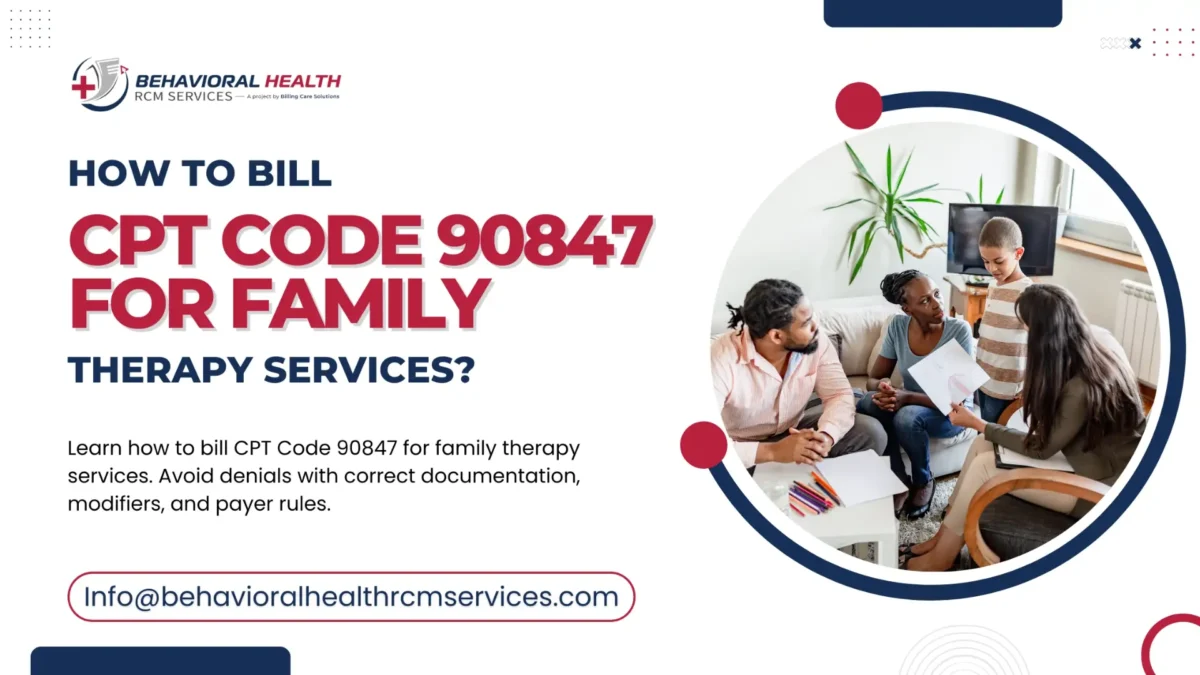
How to Bill CPT Code 90847 for Family Therapy Services?
Family engagement can be a key component to behavioral health treatment. But a session with a family member does not automatically qualify for billing as family psychotherapy. There are specific requirements that behavioral health practices need to be aware of before making claims for the CPT code 90847.
90847 represents family psychotherapy with the patient present. Accurate reporting depends on the actual service, patient participation, documentation, medical necessity, and payer requirements. CMS specifically distinguishes 90847 from family history taking and E/M counseling services.
Billing accuracy is also directly related to the business for practice leaders. Reimbursement delays, extra claim work and denials can result from incorrect code selection. These issues can be identified with a structured behavioral health RCM process, but before they impact collections.
What Is CPT Code 90847?
CPT code 90847 is Family Psychotherapy (with patient present). This service is commonly referred to as conjoint family psychotherapy and 50 minutes is listed as the service descriptor. The purpose must involve psychotherapy directed toward treatment of the patient's mental disorder. Family participation should therefore have a clinical connection to the patient's treatment.
This is not the same as a general family counseling or a gathering of information regarding family history. According to CMS, the 90846 and 90847 are not for family history taking or E/M counseling services. The clinical record should clarify the rationale for family psychotherapy. It should also show what therapeutic interventions were offered in the encounter.
When Should Providers Bill CPT code 90847?
Family psychotherapy should be reported on 90847 if the patient is present with the providers. The session should include therapeutic work that focuses on the patient's behavioral health condition. Family involvement is clinically meaningful if it impacts symptoms or treatment outcomes. Therapy can focus on communication styles, family dynamics, behavioral reactions or treatment engagement.
But, it does not constitute medical necessity if family members attend the appointment. The provider has to conduct psychotherapy and record the role of family involvement in the treatment. Medicare Guidance also suggests that claims for 90846 and 90847 should not be reported for services less than 26 minutes.
Practices need to review the actual encounter prior to choosing the code. The documentation should facilitate the care of the psychotherapy service and the patient's involvement.
Which Providers Can Bill CPT code 90847?
When appropriate and credible and as allowed by payers, qualified behavioral health professionals may report CPT code 90847 when the service is rendered. Professional qualifications, state scope of practice, enrollment and payer participation are all factors of eligibility.
Common provider types can include:
|
Provider Type |
Billing Consideration |
|
Psychiatrist |
Subject to credentialing and payer requirements |
|
Clinical Psychologist |
Subject to applicable Medicare and payer rules |
|
Licensed Clinical Social Worker |
Depends on payer eligibility and state requirements |
|
Licensed Marriage and Family Therapist |
Depends on payer participation and state rules |
|
Licensed Professional Counselor |
Depends on payer and credentialing requirements |
|
Other Qualified Professionals |
Verify individual payer requirements |
Practices should not assume that a professional license automatically guarantees reimbursement. Medicare and commercial insurers can apply different credentialing and coverage requirements.
Provider enrollment should therefore be verified before services are billed. This helps prevent otherwise accurate claims from being denied because of provider eligibility problems.
What Does CPT code 90847 Include?
A billable 90847 encounter should involve psychotherapy with the patient actively participating. Family members may participate because their interactions affect the patient's clinical condition or treatment.
The service can include working with a family system that can support symptoms of behavioral health. Can also help with communication, adherence to treatment, coping mechanisms, and family coping.
The function of the session should be documented by the provider. The record should include a clear separation between psychotherapy and administrative discussion or record.
Important elements can include:
- Patient participation
- Family participants
- Clinical problem addressed
- Psychotherapeutic interventions
- Patient response
- Family response
- Diagnosis
- Medical necessity
- Treatment goals
- Treatment plan
The documentation should show how the session contributed to treating the patient's condition. Generic notes may not adequately establish that connection.
90847 Versus 90846: Key Differences
The main difference between these codes is the presence of patients. Family psychotherapy is described in both the codes; however, 90847 specifies the presence of the patient where 90846 does not.
|
Feature |
90847 |
90846 |
|
Family psychotherapy |
Yes |
Yes |
|
Patient present |
Yes |
No |
|
Family members involved |
Yes |
Yes |
|
Conjoint psychotherapy |
Yes |
No |
|
Patient receives psychotherapy |
Yes |
No |
CMS codes 90846 are for family psychotherapy (without the patient). It classifies 90847 as family psychotherapy, patient present.
This distinction should be verified during charge capture. Staff should never select 90847 simply because family members attended the encounter.
The actual patient participation should determine which code best represents the documented service. Payer-specific requirements should also be reviewed before claim submission.
CPT code 90847 Time and Session Requirements
90847 carries a 50-minute service descriptor for family psychotherapy with the patient present. Providers should document the time spent providing the psychotherapy service according to applicable payer requirements.
Medicare guidance states that 90846 and 90847 should not be reported for services lasting less than 26 minutes. Documentation should support the reported session and demonstrate medical necessity. Longer sessions may require additional documentation when payer policies impose specific requirements.
The billing team should avoid creating unsupported time assumptions. Different payers can apply different documentation and reimbursement policies. For this reason, practices should maintain payer-specific billing guidance. That approach reduces inconsistent interpretation across behavioral health providers.
Documentation Requirements for CPT code 90847 claims
Documentation is one of the strongest controls for successful family psychotherapy billing. The clinical note should demonstrate that the patient was present and received psychotherapy.
The record should identify the family participants involved in treatment. It should also explain why their participation was clinically relevant to the patient's condition.
The provider should document specific interventions rather than simply describing family conversation. The patient's response should also be captured when clinically appropriate.
|
Documentation Element |
Billing Purpose |
|
Identified patient |
Establishes whose condition is being treated |
|
Patient presence |
Supports 90847 selection |
|
Family participants |
Shows who participated |
|
Clinical issue |
Supports medical necessity |
|
Psychotherapeutic intervention |
Demonstrates actual therapy |
|
Patient response |
Shows treatment response |
|
Diagnosis |
Supports medical necessity |
|
Treatment goals |
Establishes therapeutic direction |
|
Session duration |
Supports reported service |
Strong documentation creates consistency between the clinical encounter and the submitted claim. It also gives billing teams stronger support when payers request additional records.
Can 90847 Be Billed Without a Patient Present?
No. CPT code 90847 is a specific code for family psychotherapy treatment with patients present. When the patient refuses, the practice should consider if there is a better code to represent the service. 90846 is the corresponding family psychotherapy code when the patient is absent. However, the billing team should select the code based on the actual service provided.
Code selection should never be changed solely to obtain reimbursement. The clinical documentation and applicable payer requirements should determine the appropriate billing approach. CMS specifically distinguishes 90846 from 90847 according to patient presence.
Can CPT code 90847 Be Billed With Other Services?
Same-day behavioral health services require careful review. Multiple services can create coding conflicts when they represent overlapping or bundled work.
Potential combinations requiring review can include:
The billing team should verify applicable NCCI edits and payer-specific policies before reporting multiple services. Documentation should demonstrate that separately reported services represent distinct work when required.
A modifier should never be added simply because a claim edit appears. The clinical circumstances must support any modifier used.
Can Modifier 59 Be Used With CPT code 90847?
Modifier 59 is not required to be always included with 90847. It is designed for specific situations with special services of procedure. A billing team should first determine whether a valid coding edit exists. It should then confirm that the clinical documentation supports reporting the services separately.
Modifier use should reflect the actual circumstances of the encounter. It should never become a routine strategy for bypassing payer edits. This approach reduces unnecessary modifier use and supports cleaner claims. It also gives the practice stronger documentation if the payer later reviews the encounter.
Place of Service Billing Rules for CPT code 90847
Place of service reporting should match where the psychotherapy service occurred. Behavioral health practices should avoid using a default POS without confirming the actual setting.
Common POS codes relevant to 90847 include:
|
POS Code |
Place of Service |
|
11 |
Office |
|
10 |
Telehealth in Patient's Home |
|
02 |
Telehealth Other Than Patient's Home |
|
12 |
Home |
|
22 |
On-Campus Outpatient Hospital |
|
31 |
Skilled Nursing Facility |
|
32 |
Nursing Facility |
CMS states that psychotherapy codes can apply across settings. The reported POS should still accurately represent the service location. Incorrect POS reporting can create inconsistencies between clinical documentation and claim data. Those inconsistencies may contribute to claim processing problems or additional payer review.
CPT code 90847 Telehealth Billing Guidelines
Many behavioral health patients have been able to access family psychotherapy through telehealth. But, with the remote family sessions, it's still important to have accurate location and billing information. POS 10 applies when the patient receives telehealth services from home. POS 02 applies when the patient receives telehealth somewhere other than home.
The billing team should verify the patient's location for applicable telehealth encounters. It should also confirm current payer requirements for modifiers and other telehealth reporting.
Family engagement may be done remotely as part of the same telehealth encounter. The participants and their clinical involvement should be clearly documented. Payer rules are subject to change, so it is advisable for practices to review rules regularly. A payer-specific telehealth matrix will be useful to staff for applying the same rules to different payers.
What Diagnosis Codes Support CPT 90847?
CPT code 90847 does not have one specific diagnosis code. The diagnosis should reflect the patient's chronic mental health status.
Accurate diagnosis will outline the rationale for family psychotherapy for the patient. Documentation should be linked to family involvement, symptoms, and clinical interventions.
The following are only a few examples of diagnosis codes that could be used for CPT code 90847. Selected ICD-10-CM code should correspond with the patient's documented diagnosis.
|
Diagnosis Category |
Example ICD-10-CM Codes |
When 90847 May Apply |
|
Major depressive disorders |
F32.0, F32.1, F33.1 |
Family involvement supports treatment and symptom management |
|
Anxiety disorders |
F41.1, F41.9 |
Family participation addresses anxiety-related treatment needs |
|
Post-traumatic stress disorder |
F43.10 |
Family therapy supports trauma-related treatment goals |
|
Bipolar disorders |
F31.9, F31.81 |
Family participation supports mood disorder management |
|
Schizophrenia spectrum disorders |
F20.9 |
Family involvement supports ongoing psychiatric treatment |
|
Adjustment disorders |
F43.21, F43.23 |
Family therapy addresses adjustment-related symptoms |
|
Other behavioral disorders |
F43.89, F90.9 |
Family participation supports documented behavioral treatment needs |
Billing teams must steer clear of choosing diagnoses just because they often co-occur with 90847. Unsupported diagnosis coding may present medical necessity issues, denial risks and compliance risks.
The clinical note should link the diagnosis, therapeutic goals, family connection and psychotherapy interventions for stronger claims. This establishes a medical necessity record for the payers' review.
For stronger claims, the clinical note should connect the diagnosis, treatment goals, family involvement, and psychotherapy interventions. This creates a clearer medical necessity trail for payer review.
Common CPT Code 90847 Billing Errors
Many 90847 billing problems begin with incorrect charge capture. Staff may select the code based on family participation without reviewing whether the patient actually participated. Another common problem involves documenting family discussion without documenting psychotherapy. Payers may question medical necessity when the note does not show therapeutic intervention.
Common errors include:
- Billing 90847 without patient participation
- Using 90847 for family history
- Reporting general family counseling as psychotherapy
- Missing medical necessity
- Using an unsupported diagnosis
- Incorrect POS reporting
- Incorrect telehealth reporting
- Unsupported modifier use
- Incomplete participant documentation
- Ignoring payer-specific requirements
Each error can increase claim rework. Repeated problems can also increase A/R and reduce billing team productivity.
Why Do CPT code 90847 Claims Get Denied?
90847 denials can result from clinical, administrative, or coding problems. The exact denial reason should be identified before correcting the claim.
|
Denial Cause |
Potential Revenue Impact |
|
Patient not present |
Incorrect code selection |
|
Medical necessity issue |
Claim denial |
|
Unsupported diagnosis |
Payment delay or denial |
|
Authorization problem |
Nonpayment risk |
|
Eligibility issue |
Unpaid encounter |
|
Provider credential issue |
Claim rejection |
|
Incorrect POS |
Processing delay |
|
Telehealth error |
Claim rejection |
|
Duplicate service |
Duplicate billing denial |
|
Documentation gap |
Medical record request |
A denial should not automatically trigger a CPT code change. The billing team should first determine whether the original claim accurately represented the encounter. This approach helps distinguish correctable billing errors from genuine coverage limitations. It also improves denial reporting for leadership.
How Can Practices Prevent CPT code 90847 Denials?
Preventing 90847 denials requires accurate documentation and careful coding. Practices should focus on these key areas:
- Clearly document patient presence during family psychotherapy.
- Explain how family participation supports treatment.
- Support medical necessity through diagnosis and treatment goals.
- Document the session duration accurately.
- Select an appropriate ICD-10-CM diagnosis code.
- Report the correct place of service.
- Follow applicable payer and telehealth requirements.
- Use modifiers only when properly supported.
- Review claims for coding and documentation inconsistencies.
These checks can reduce preventable denials and strengthen reimbursement for CPT code 90847.
CPT Code 90847 Reimbursement and RVU Values
Understanding reimbursement requires reviewing both RVUs and payment rates. Medicare uses work, practice expense, and malpractice RVUs within its Physician Fee Schedule methodology. Geographic adjustments also affect final payment.
|
90847 Value |
Non-Facility |
Facility |
|
Work RVU |
2.86 |
2.86 |
|
Practice Expense RVU |
0.40 |
0.20 |
|
Malpractice RVU |
0.02 |
0.02 |
|
Total RVUs |
3.28 |
3.08 |
|
2026 National Medicare Amount |
$109.55 |
$102.87 |
The national quantities in the above tables are calculated with the national GPCI assumption of 1.000 and a national non-QP conversion factor of $33.4009. This CMS RVU file update is for Q4 2026.
These figures provide a Medicare national baseline. Actual payment can vary by geographic locality, provider circumstances, and payer policy.
Commercial reimbursement can differ significantly from Medicare. Contracted rates should therefore be used when evaluating actual payer performance.
90847 Medicare Versus Commercial Reimbursement
Medicare provides a useful benchmark for financial analysis. However, behavioral health practices should not assume that commercial insurers reimburse the same amount.
Commercial payment depends on the provider's contract and network status. Payer-specific fee schedules can also produce substantial differences between insurers.
Practice leaders should compare expected and actual payments by payer. This helps identify underpayments and unfavorable reimbursement patterns.
A useful payer analysis can include:
- Contracted allowed amount
- Actual allowed amount
- Payment received
- Patient responsibility
- Denial rate
- Underpayment rate
- Appeal recovery
- Average days to payment
This analysis provides more useful financial information than simply counting submitted claims. It also helps identify which payer relationships require additional attention.
How 90847 Errors Affect Behavioral Health Revenue
A denied family psychotherapy claim creates more than a temporary payment problem. It also creates administrative work for coding, billing, denial management, and A/R teams. Repeated errors can increase the number of claims requiring manual intervention. This increases the cost of collecting revenue from completed services.
Delayed claims also affect cash flow visibility. Leadership may see completed encounters in production reports while expected reimbursement remains outstanding. CFOs should therefore connect 90847 billing performance with financial KPIs. This provides a clearer picture of how efficiently completed services become collected revenue.
90847 Revenue Cycle KPIs to Monitor
Tracking 90847 separately can reveal problems hidden inside overall behavioral health performance. Family psychotherapy may have different denial patterns from individual psychotherapy.
|
KPI |
What It Measures |
|
Clean Claim Rate |
First-pass billing accuracy |
|
Denial Rate |
Frequency of payment failures |
|
Average Allowed Amount |
Payer reimbursement |
|
Net Collection Rate |
Revenue actually collected |
|
Days in A/R |
Collection speed |
|
Appeal Recovery Rate |
Denial recovery performance |
|
Underpayment Rate |
Contract payment accuracy |
|
Rework Rate |
Administrative billing burden |
Leadership should review these metrics by payer and service setting. This can reveal whether problems originate from coding, authorization, documentation, or payer contracts.
90847 Billing Workflow for Behavioral Health
A strong billing workflow connects clinical documentation with financial controls. Each stage should have a clear verification point.
- Patient Intake
- Eligibility
- Authorization
- Provider Validation
- Family Session
- Documentation
- Coding
- Claim Submission
- Payment Posting
- Denial Management
- A/R Follow-Up
Eligibility and authorization should be reviewed before services whenever applicable. Provider credentials should also be confirmed before claims are submitted.
After the session, the billing team should validate the documentation. Patient presence, diagnosis, POS, and payer-specific requirements should be checked before submission.
Payment posting should compare actual reimbursement with expected payment. Underpayments and denials should then enter the appropriate follow-up workflow.
How Behavioral Health RCM Services Support 90847 Billing
Specialized behavioral health RCM support can strengthen the billing controls surrounding family psychotherapy. The objective should be accurate claims and stronger revenue visibility. RCM teams can support eligibility verification and authorization checks before services. They can also review documentation, coding, POS, and telehealth requirements after encounters.
Denial management provides another important control. Teams can identify recurring payer problems and determine whether corrective action belongs in intake, coding, or follow-up workflows.
Payment analysis can also identify underpayments. Comparing actual reimbursement against contracted expectations helps practices monitor payer performance. Behavioral Health RCM Services can support these workflows through specialized behavioral health billing processes. The strongest approach connects claim accuracy with measurable financial outcomes.
90847 Billing Compliance Checklist
Before submitting a 90847 claim, practices should verify the following:
- Confirm the patient was present.
- Verify family psychotherapy was provided.
- Confirm treatment focused on the patient.
- Validate the diagnosis.
- Confirm medical necessity.
- Verify provider eligibility.
- Review family participant documentation.
- Confirm session documentation.
- Validate the place of service.
- Check telehealth requirements.
- Review modifier requirements.
- Check same-day coding edits.
- Verify payer-specific policies.
- Review the claim before submission.
An established checklist minimizes variations between the billing staff. It also introduces a practical quality control system for behavioral health practices.
Key Takeaways
The CPT code 90847 is used for family psychotherapy in the presence of the patient. The service shall include psychotherapy which is directed towards treatment of the mental disorder of the patient. The difference between the codes 90847 and 90846 stems from the requirement for patient presence. It is not appropriate just because it is used by families.
Documentation should exhibit family engagement, patient engagement, clinical need, therapeutic intervention, and treatment response. Also, consistency of diagnosis and medical necessity should be maintained throughout the record.
Denial tracking, reimbursement, A/R and payer performance indicators give behavioral health leaders a better handle on the money. The work of RCM controls can prevent significant billing challenges and enhance the collection process.