Understanding HCPCS vs CPT for Behavioral Health Billing
April 21, 2026
Understanding CPT Code 96137: When and How to Use It Correctly
May 7, 2026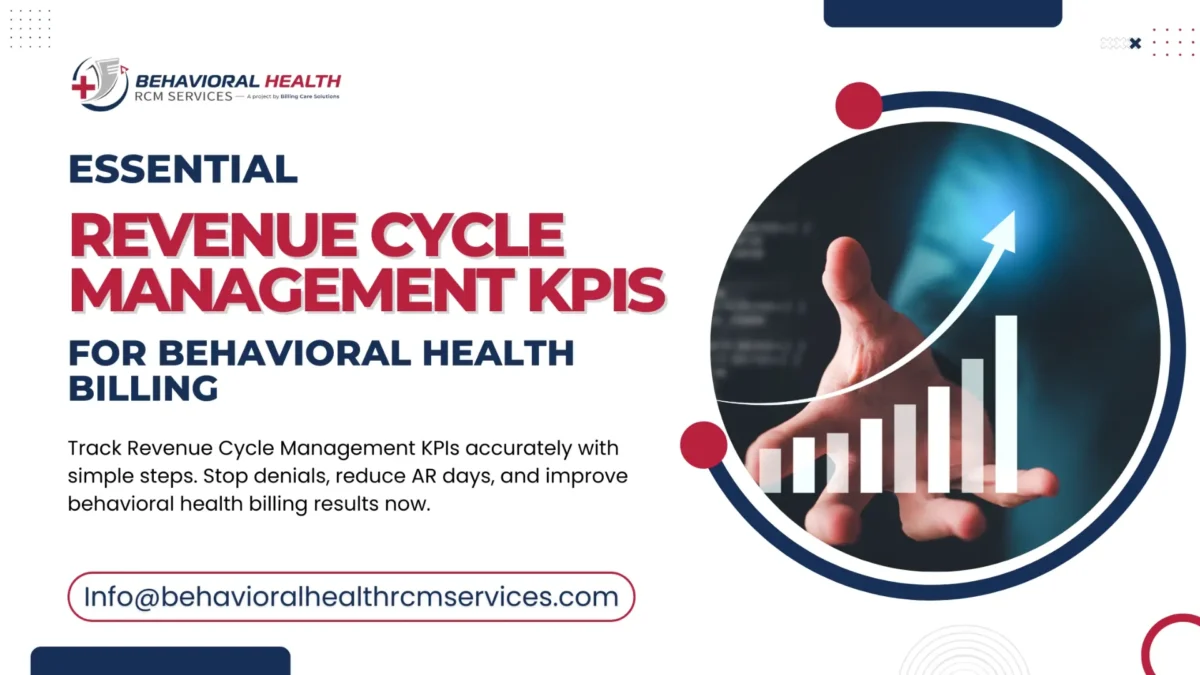
Essential Revenue Cycle Management KPIs for Behavioral Health Billing

Operating a behavioral health practice goes beyond providing excellent clinical care. To serve your patients in the long run, you require a financially sound organization to serve your patients. Financial health is best measured by monitoring the appropriate Revenue Cycle Management KPIs. These key performance indicators will give you a close understanding of where your billing process is performing well or poorly.
In the case of behavioral health providers, general medical standards are not usually applicable. Payer policies differ. Rules in authority are more restrictive. Denial reasons vary. This is why it is necessary to pay attention to Revenue Cycle Management KPIs targeted at mental health and substance use disorder billing. In absence of such metrics, you are making an educated guess about the health of your revenues. You also make data driven decisions with them to enhance cash flow and lessen administrative stress.
In this blog, we will take you through the most significant Revenue Cycle Management KPIs in behavioral health billing. Each section describes what to quantify, why this is important, and how you can increase your revenue.
Why Revenue Cycle Management KPIs Matter in Behavioral Health?
Behavioral health billing has unique challenges. A lot of payers require prior authorization of therapy sessions. Others restrict the visits per year. Others require particular documents in order to be a medical necessity. General Revenue Cycle Management KPIs do not account for these hurdles.
The correct Revenue Cycle Management KPIs are used to determine bottlenecks. As an example, the large denial rate may indicate authorization issues. They might indicate a problem with patient payments as a result of a low collection rate. These insights are essential without which you cannot repair what is broken. Having clear metrics, you are going at the root cause and guarding your revenue cycle.
Top Denial Rate Metrics for Behavioral Health Claims
One of the most telling Revenue Cycle Management KPIs is the Denial rate. It is used to determine the percentage of claims that are rejected by payers. Common denial reasons in the area of behavioral health have been identified as the missing authorization numbers, incorrect diagnosis codes, and the timely filing errors.
In order to compute your denial rate, you will divide denied claims to the total claims submitted. Then add a hundred. A healthy denial rate for behavioral health is below ten percent. If your rate is higher, review your front end processes. Check clearing monitoring and selection of codes. By cutting down on denials by a modest five percent, you can add thousands of dollars to your monthly earnings.
Tracking Clean Claim Submission Rates Weekly Without Fail
Clean claim rate informs you about the number of the claims that have passed through without being rejected. It is a Revenue Cycle Management KPIs that is a direct measure of your billing accuracy. Manual correction is not required in clean claims. They bypass payment.
In the case of behavioral health, have a clean claim rate of more than ninety five percent. To do this, make sure that the insurance of the patients is checked at each visit. Confirm active authorizations. Use accurate CPT and ICD codes. By enhancing this Revenue Cycle Management KPIs, you can accelerate payment and decrease rework. Your employees waste less time running around to seek denials and more on constructive activities.
Measuring Days in Accounts Receivable Over 90
Days in accounts receivable or AR is a measure of the number of days it takes to receive payment. This Revenue Cycle Management KPI is used to monitor the average time between the service date and payment date. In the case of behavioral health, a healthy AR is less than forty days.
Consider AR more than ninety days. Hard to gather old claims. Most payers have ninety to a hundred and twenty days as timely filing limits. If a claim sits beyond that window, you lose the right to payment. Review your AR aging report weekly. Identify claims older than ninety days. Work on them immediately. Keeping this Revenue Cycle Management KPI low protects your write offs.
First Pass Resolution Rate for Therapy Services
The first pass resolution rate is the rate at which the claims are paid on the first submission. This KPI of RCM extends past clean claims. You can have a claim that is clean and yet does not pay. First pass resolution refers to the fact that you have been fully paid without any appeals or follow up.
With behavioral health, first pass resolution is often harmed by partial payments or an incorrect allowed amount. Monitor this Revenue Cycle Management KPI by payer. Once you see a pattern, make an appeal in a systematized manner. Enhanced first pass resolution will save hours of collection effort.
Net Collection Rate Versus Gross Collection Rate
The most truthful RCM KPI is your net collection rate. It is the amount of what you actually collected and what you were permitted to collect following contractual adjustments. The gross collection rate is a comparison of your collection to the full charges you would have charged.
The high net collection rate of behavioral health is ninety five per cent or more. When your net collection rate is low, review your patient collections and denial appeals. This Revenue Cycle Management KPI shows the actual functionality of your whole revenue cycle. It takes into consideration write offs, adjustments and bad debt.
Patient Responsibility Collection Percentage at Check In
Patient responsibility will involve copays, deductibles, and coinsurance. This is a key RCM KPI which must be collected at check in. This is a problem that many behavioral health practices grapple with. Patients can lose the means of payments. Employees might not be comfortable requesting funds.
But not gathering within your revenue damages your income. As soon as the patient has gone, the success of the collection reduces drastically. Measure this KPI on a weekly basis in Revenue Cycle Management. Training your front desk: It is important to train your front desk to make sure that they check the patient balances before every patient visit. Use automated payment reminders. As we increase collection at check in to more than ninety percent, cash flow is improved instantaneously.
Authorization Utilization Rate for Continued Care
Utilization rate of authorization is the amount of authorized visits that you actually use and bill. This KPI of Revenue Cycle Management in behavioral health is unique. The number of sessions that will be approved by the payers is often fixed, e.g., twelve visits. When you leave only eight to the bill you are leaving revenue on the table.
Monitor this RCM KPI both on a patient and payer basis. Follow up visits Schedule Schedule follow up visits ahead of expiration of authorization. In your EHR, notify the staff when a patient is near the end of his or her authorized session. Enhancing the rate of utilization will enhance the revenue without necessarily increasing the number of patients. It is among the simplest Revenue Cycle Management KPIs to enhance with straightforward workflow modifications.
Timely Filing Compliance Score by Payer Type
Timely filing compliance measures how often you submit claims within payer deadlines. This RCM KPI is non-negotiable. Most commercial payers have ninety day limits. Medicare has twelve months. Medicaid varies by state.
Track your timely filing compliance score for each payer type. A score below ninety five percent is a red flag. Late claims are automatically denied. You cannot appeal a timely filing denial. Use this RCM KPI to enforce strict submission schedules. Bill all claims within forty eight hours of service. Automate clearinghouse submissions. Never let a payer deadline pass unused.
Using Revenue Cycle Management KPIs to Reduce Denials
Tracking Revenue Cycle Management KPIs is not enough. You must act on the data. Use your denial rate and first pass resolution metrics to find patterns. One behavioral health practice discovered that sixty percent of denials came from a single payer for authorization issues. They retrained their authorization team and cut denials in half within sixty days.
Make denial management a weekly habit. Review your top five denial reasons. Create simple checklists for the front desk and billing staff. When you close the loop on these Revenue Cycle Management KPIs, your revenue becomes more predictable and stable.
Rework Rate for Corrected Behavioral Health Claims
Rework rate measures how many claims need correction after initial submission. This RCM KPI is a hidden cost. Every corrected claim takes staff time. It delays payment. It increases frustration.
For behavioral health, a low rework rate is below five percent. Common rework causes include wrong patient demographics, missing referring provider information, and incorrect place of service codes. Use your Revenue Cycle Management KPIs to identify these errors at the source. Train intake staff to verify every data field. Reduce rework and watch your productivity rise.
Payer Specific Acceptance Rate for Common Codes
Not all payers treat behavioral health codes equally. This RCM KPI tracks how often each payer accepts and pays your most common codes, such as 90791 for diagnostic assessment or 90837 for psychotherapy.
Calculate acceptance rate by dividing paid claims by submitted claims per payer. If a specific payer rejects 90837 frequently, investigate. Maybe they require a different modifier or prior authorization. Use this RCM KPI to guide your billing strategy. Focus appeals on the lowest performing payers first.
Write Offs Due to Missing or Expired Authorizations
Authorization related write offs are painful and avoidable. This Revenue Cycle Management KPIs tracks how much revenue you lose because a patient did not have a valid authorization at the time of service.
Many behavioral health providers discover that five to ten percent of their write offs come from expired authorizations. Track this RCM KPI monthly. Build authorization tracking into your scheduling workflow. Verify authorization status before every appointment. When you eliminate these write offs, you save thousands of dollars without seeing one extra patient.
Dashboard Setup for Revenue Cycle Management KPIs
A dashboard will allow you to keep track of the Revenue Cycle Management KPIs at a glance. Simple spreadsheet software or your practice management system. Included are the ten most important measures: denial rate, clean claim rate, days in AR, net collection rate, patient collection percentage, authorization utilization, cost to collect, bad debt percentage, timely filing compliance, and rework rate.
Record on your dashboard once a week. Send it to your billing department. Celebrate improvements. Investigate declines. Once Revenue Cycle Management KPIs become an integral part of your routine operations, there will be no financial surprises.
Benchmarking Your KPIs Against Industry Standards
Benchmarking will match your Revenue Cycle Management KPIs to other behavioral health practices. Relate industry survey data or professional organizations. When you have a net collection rate of ninety percent and the benchmark of ninety five percent you know you can improve.
Comparisons with general medicine should be avoided. There are special problems with behavioral health. Only use behavioral health specific benchmarks. Monitor your KPIs of RCM over time. It is about progress as opposed to being perfect on day one.
Conclusion
Mastering Revenue Cycle Management KPIs transforms behavioral health billing from reactive to proactive. You stop guessing why cash flow is slow. You know exactly which metrics need attention. By focusing on denial rates, accounts receivable days, authorization tracking, and patient collections, your practice improves financial stability and reduces administrative stress.
Start small. Pick three Revenue Cycle Management KPIs to track this week. Denial rate, clean claim rate, and days in AR are excellent starting points. Measure them. Review them weekly. Make one improvement at a time. Within ninety days, you will see real results. Sustainable revenue health is built one KPI at a time. Let Behavioral Health RCM Services help you track and improve every step of your billing cycle.